Division 01 / Second Spark Intelligence
Battery Passport
Zimbabwe is absorbing an enormous volume of imported lithium storage, and almost none of it arrives with an honest account of what is left inside. We test at cell level, grade what we find, and give the battery a record that travels with it.
Cell-level testing · Grading · Certification · Continuous monitoring
The problem
A market trading blind.
Imports arrive unlabelled
Second-hand lithium packs enter the country re-cased, re-badged and stripped of history. The nameplate capacity printed on the side stopped being true years ago, and nothing on the pack tells you by how much.
The buyer carries all the risk
There is no practical way to tell a pack at ninety percent health from one at forty at the point of sale. Price becomes guesswork, warranties become unwritable, and trust in the whole market erodes.
Good cells get scrapped
Packs are condemned whole when a handful of cells have failed. Recoverable capacity goes into the e-waste stream alongside the genuinely dead — expensive for the owner and avoidable for everyone.
How it works
From unknown pack to verified record.
Intake and identification
The pack is logged, opened and mapped: chemistry, configuration, cell count, module layout, and whatever history the battery management system still holds. Every pack gets a permanent identifier at this point.
Cell-level testing
We test each cell individually rather than reading the pack as one unit. A pack-level reading hides the weak cells that will actually determine its life — a single failing cell caps the whole string, and only cell-level work finds it.
Scoring and grading
Measurements resolve into a state-of-health figure and a grade band, with the weakest cells and their effect on usable capacity called out separately. You get the number and the reasoning behind it.
The passport is issued
Packs that meet the standard earn a Second Spark passport: a verifiable record of what was measured, when, by whom, and what grade it earned. It stays with the battery when it is sold on.
Continuous monitoring
The passport keeps updating in service. Live state-of-health tracking means the owner is told a pack is drifting while there is still time to act, instead of finding out when it fails.
What we measure — 06
Six readings, taken per cell.
A pack-level test tells you what the weakest cell allows. Testing every cell tells you which cell that is, how far behind it has fallen, and whether the pack is worth recovering.
Usable capacity
Actual amp-hours delivered per cell under controlled discharge, against the rated figure.
Internal resistance
Impedance per cell — the earliest reliable signal of ageing, and often visible long before capacity drops.
Voltage spread
Cell-to-cell divergence and how well the pack holds balance across a full charge cycle.
Round-trip efficiency
How much of the energy put into the pack comes back out, and where the rest is being lost.
Thermal behaviour
Temperature response under load and during charge, including cells that run hot relative to their neighbours.
Cycle history
Recorded cycles where the BMS retains them, plus an estimated age derived from the measured degradation curve.
The passport — 04 grades
One number, and the reasoning behind it.
State of health is expressed as a percentage of original rated capacity and resolved into one of four bands. The passport carries the grade, the underlying measurements, the test date and the pack identifier — so a buyer can check it rather than take it on faith.
Effectively as-new. Cell spread tight, no thermal outliers. Suitable for demanding duty cycles and full-price resale.
Strong remaining service life with normal, even degradation. The bulk of well-kept imported stock lands here.
Serviceable, priced accordingly, and best matched to lower-demand duty — backup, light cycling, stationary storage.
Not passported for resale. Routed instead into recovery: cell-level triage, rebuild where it is worth it, certified recycling where it is not.
The monitor
We leave hardware on the pack.
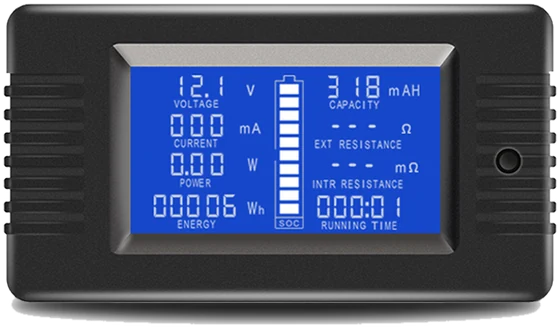
Testing tells you what a pack is worth on the day it is tested. The monitor we fit tells you what it is doing every day after — reading the pack in service and feeding the same measurements back into the models that set its grade.
- Voltage
- Pack terminal voltage, live
- Current
- Draw and charge rate in real time
- Power
- Instantaneous load on the pack
- Energy
- Cumulative watt-hours in and out
- Capacity
- Charge counted through the pack
- Internal resistance
- The earliest signal of ageing
- State of charge
- Where the pack sits right now
- Running time
- How long it has been under load
Monitoring — 03
The passport keeps working after the sale.
Live state of health
Capacity, resistance and balance tracked over time rather than captured once, so the curve — not a single reading — tells you where the pack is going.
Alerts before failure
Every pack we test feeds the models. As the dataset grows, so does our ability to say when a specific pack will need attention — and to tell its owner in advance rather than after.
Fleet reporting
For operators running many packs, one view across all of them: grades, trends, packs approaching a threshold, and what to schedule next.
Recovery — 03
A failing pack is not a dead pack.
Cell-level triage
We find the specific cells dragging a pack down instead of writing off the whole assembly. Usually it is a small minority of them.
Rebuild and re-grade
Weak cells are replaced or rematched, the pack is rebalanced, retested, and issued a fresh passport at its new grade.
Certified recycling
What genuinely cannot be recovered goes to recyclers with a record of what it contained, so the material is recovered properly instead of ending up in general waste.
Who it is for
Anyone holding a pack they cannot see inside.
| Segment | What they get | Why it matters |
|---|---|---|
| Importers & retailers | Graded stock with a passport buyers can check | Sell on evidence instead of assurance, and price each pack for what it is |
| Solar & backup installers | Verified capacity before the pack goes on a wall | Size systems on real numbers and stop inheriting other people’s failures |
| Fleet & telecom operators | Continuous monitoring across every pack in service | Replace on schedule rather than after an outage |
| Recyclers | Triage that separates recoverable from genuinely spent | Keep working capacity in service and recover the rest cleanly |